Low Profit Margins for Battery Swap Operators Four Additional Revenue Modes to Expand Project Income
Low Profit Margins for Battery Swap Operators? Four Additional Revenue Modes to Expand Project Income
Competition in the battery swap industry grows increasingly fierce, pushing most operators into profit bottlenecks. The vast majority of entrepreneurs adopt an overly single profit model that only relies on one-time swap service fees. Vulnerable to seasonal fluctuations, passenger flow shifts and price wars among competitors, single-cabinet revenue stays slim, payback cycles extend drastically, and many sites operate at marginal profit or even sustained losses. Numerous new entrepreneurs mistakenly believe swap service fees represent the only income stream for battery swap cabinets. In reality, intelligent battery swap cabinets are multi-functional public smart devices with strong diversified revenue expansion potential.
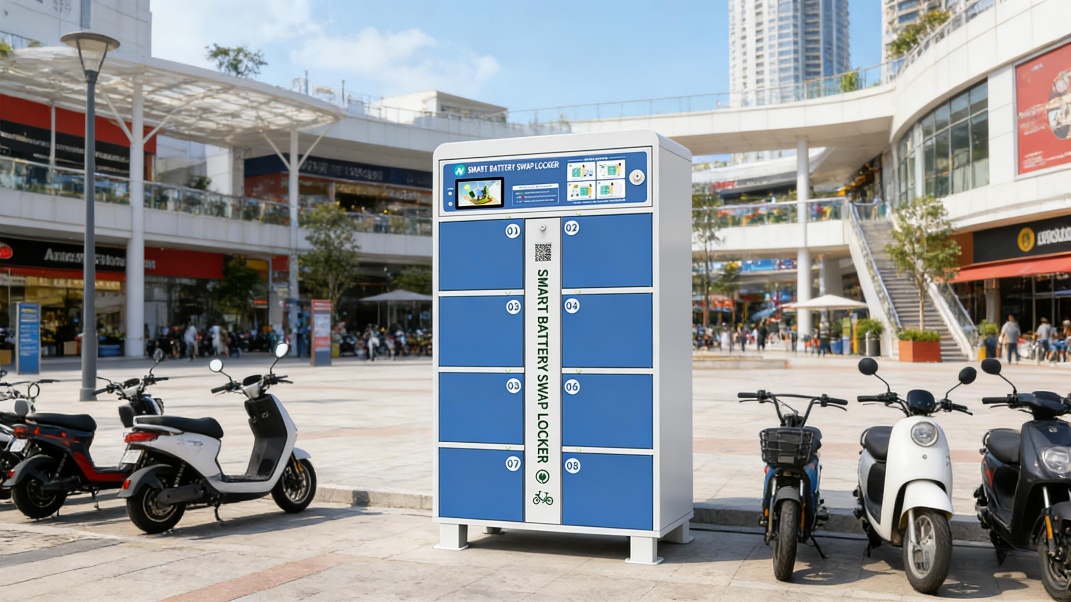
To break profit bottlenecks and lift overall project competitiveness, operators must abandon single-revenue thinking and expand multiple income channels leveraging swap cabinet hardware and software to build a multi-dimensional profit system combining core service revenue and auxiliary extra income. Four implementable extra revenue models widely adopted across the industry quickly raise net profit and shorten payback cycles for operators.
First, passive income from cabinet outdoor advertising. Intelligent battery swap cabinets are mostly placed at residential compound entrances, main business district roadsides and rider gathering points with dense pedestrian flow, serving as natural offline outdoor advertising carriers. Premium battery swap cabinets reserve high-definition display areas on cabinet bodies to support static posters and dynamic video rotation playback. Operators can cooperate with local electric vehicle stores, parts suppliers, supermarkets and daily service merchants to charge monthly or quarterly advertising fees. Residential sites prioritize daily life service advertisements, while rider-focused sites feature travel, delivery and auto repair promotions. Precise targeted traffic delivers high conversion rates, generating long-term passive extra income without extra operation labor, with considerable annual advertising revenue per single cabinet.
Second, additional rental income from integrated swap & rental functions. Traditional single-function swap cabinets only satisfy instant battery replacement demands and fail to fully utilize battery resources. Intelligent battery swap cabinets supporting integrated swap & rental modes freely switch between two operation modes to fit diverse user needs. For daily commuting residents, launch monthly, quarterly and annual battery rental packages, allowing users to avoid purchasing expensive lithium batteries and pay regular rental fees, generating steady long-term rental revenue for operators. For short-distance trips and temporary vehicle use, offer short-term hourly rental services to activate idle batteries, maximize resource utilization and create extra revenue streams.
Third, diversion split income via cross-industry traffic cooperation. Battery swap cabinet sites gather precise local permanent residents and delivery riders, carrying high offline diversion value for surrounding physical merchants. Operators can establish cooperative partnerships with community convenience stores, electric vehicle repair shops, car wash shops and hardware stores nearby. Promote partner merchants via cabinet screen ads, WeChat group pushes and offline guidance to deliver precise customer traffic, earning diversion commissions based on transaction volume or in-store consumption amount. This local traffic holds high precision and stable repeat purchase rates, forming sustainable cross-industry income channels accumulated over long-term cooperation.
Fourth, cost reduction revenue via energy-saving control, lifting net profit from the cost side. Battery swap cabinets run 24/7 year-round, with electricity bills forming core daily operation costs. Rational cost control equals direct profit growth. Intelligent battery swap cabinets are equipped with energy-saving control systems that automatically charge batteries during off-peak low-price electricity periods and enter standby mode during high-price peak hours, cutting electricity expenditure significantly via peak-valley power shifting. Outdoor sites can be matched with photovoltaic energy storage equipment to further reduce power costs using solar energy. Meanwhile, remote operation and maintenance functions cut manual inspection and repair frequency, lowering labor maintenance costs and boosting net profit by controlling expenditure.
Diversified profit streams form the core of long-term sustainable battery swap business development, and equipment functional expandability directly determines the upper limit of project profitability. Hardware and software configurations adapted to multi-channel extra revenue completely break single-service revenue bottlenecks. Panzhong Technology has long focused on optimizing functional design of battery swap equipment, developing intelligent swap cabinets fitting diversified profit expansion to help operators lift overall project profit margins comprehensively.

表单2
邮件*
*