The Battery Swapping Cabinet Solution for Electric Motorcycles in Vietnam
In-depth Introduction to the Battery Swapping Cabinet
Solution for Electric Motorcycles in Vietnam
I. Introduction: The Frontier of Southeast Asia's Electric Vehicle Transformation
Vietnam, a Southeast Asian country with a population of nearly 100 million and over 60 million motorcycles in possession, is undergoing a profound transformation in transportation energy. As one of the leading electric two-wheeler markets in the ASEAN region, Vietnam's electric motorcycle market is growing rapidly, with sales surging by nearly 100% year-on-year in the first half of 2025, making it the world's third-largest electric motorcycle consumer market. In this transition, the shortage of charging infrastructure has become a key bottleneck restricting the popularization of electric motorcycles. To address this challenge, the battery swapping cabinet solution has emerged as a core infrastructure of Vietnam's electric motorcycle ecosystem, thanks to its high efficiency, convenience, safety and reliability.
This paper systematically analyzes the battery swapping cabinet solution for electric motorcycles in Vietnam from multiple dimensions, including technical principles, policy environment, market status and operation models, aiming to provide a comprehensive reference guide for industry practitioners, investors and relevant policy makers.
II. Market Background and Development Opportunities of Electric Motorcycles in Vietnam

2.1 Electrification Transition of the "Kingdom of Motorcycles"
Vietnam is known as the "Kingdom of Motorcycles", and motorcycles are the primary means of transportation for its people. Ho Chi Minh City, the city with the largest number of motorcycles in Vietnam, bears huge travel demand. However, with rising oil prices, growing environmental awareness and stricter urban management requirements, electric motorcycles are gradually becoming an alternative to fuel-powered motorcycles.
The explosive growth of the electric motorcycle market is driven by multiple factors: the pressure of rising oil prices on usage costs, the promotion of environmental policies, the green transformation of consumer behavior, and the overall rapid expansion of the two-wheeler electric vehicle market. The Vietnamese government plans to restrict the use of fuel-powered motorcycles in city centers by 2030, and this policy expectation has further accelerated the development of the electric two-wheeler and battery swapping market.
2.2 Pain Points of Charging Infrastructure and the Rise of Battery Swapping Mode
The traditional charging mode faces many challenges in Vietnam: long charging time (usually 4-6 hours), insufficient charging facilities, prominent potential safety hazards, and large space occupation, which seriously restrict user experience. Especially in big cities such as Ho Chi Minh City and Hanoi, where the population is dense and living space is limited, the installation of private charging piles is extremely difficult.
The battery swapping mode effectively solves the above pain points with its unique advantages: users only need to put low-power batteries into the swapping cabinet and take out fully charged batteries to complete energy replenishment, and the whole process takes only about 2 minutes, greatly improving convenience. Meanwhile, battery swapping cabinets occupy a small area and are easy to rent and connect to electricity, making them more suitable for deployment in the high-density urban environment of Vietnam.
III. In-depth Analysis of the Technical Architecture of the Battery Swapping Cabinet Solution
3.1 Overview and Working Principle of the Battery Swapping Cabinet System
A battery swapping cabinet is an intelligent device integrating battery replacement, automatic control and Internet of Things (IoT) communication technologies, which solves the range anxiety of electric vehicles by "swapping batteries" instead of traditional "charging". Its core concept is to separate batteries from vehicles to form independent energy units, and realize the rapid circulation and continuous energy replenishment of batteries through a standardized swapping cabinet network.
The workflow can be summarized as follows:
Users identify their identity via mobile APP or QR code scanning.
The swapping cabinet automatically recognizes the user account and battery status.
The system opens an empty slot, and the user puts in the low-power battery.
The system checks the battery information and then opens the fully charged slot.
The user takes out the fully charged battery to complete the swap.
The background system records transaction data and updates the user balance.
The whole process relies on the Battery Management System (BMS) to accurately monitor battery status, including real-time collection and analysis of key parameters such as temperature, voltage, current and state of charge.
3.2 Battery Technical Standards and Chemical Types
3.2.1 National Battery Technical Standards of Vietnam
Vietnam has established a relatively complete technical standard system for electric motorcycle batteries. QCVN 91:2024/BGTVT National Technical Standards for Traction Batteries of Electric Motorcycles and Electric Mopeds issued by the Ministry of Transport of Vietnam is the core mandatory specification in the battery field of the country.
This standard applies to batteries for electric motorcycles produced, assembled or imported in Vietnam, covering various types such as lead-acid batteries, nickel-metal hydride batteries and lithium-ion batteries, including detachable and non-detachable batteries. The main technical requirements include:
Electrical performance requirements: The measured voltage of the battery shall not be lower than the rated voltage with a fluctuation of no more than 15%; the measured capacity of lead-acid batteries shall not be less than 90% of the rated capacity, and that of nickel-metal hydride and lithium-ion batteries shall reach 100% of the rated capacity; lead-acid batteries shall also meet the requirement of high-current discharge for no less than 40 minutes.
Safety performance requirements: Batteries must pass a number of stringent tests such as overcharge, over-discharge, vibration resistance, short circuit, water immersion and drop test, and no potential safety hazards such as leakage, combustion, explosion or rupture shall occur during and within 1 hour after the tests.
Marking and structure requirements: Batteries must be clearly marked with positive and negative poles, with no deformation or cracking on the shell, and the rated voltage and capacity markings must be durable and clear; high-voltage batteries must also be marked with special warning signs.
3.2.2 Mainstream Battery Chemical Types
In the battery swapping cabinet solution, Lithium Iron Phosphate (LiFePO4) batteries have become the mainstream choice in the Vietnamese market due to their high safety, long cycle life and relatively low cost. Taking a 72V 20Ah LiFePO4 battery as an example, it has good thermal stability and a cycle life of more than 2000 times, which is especially suitable for high-frequency charging and discharging in battery swapping scenarios.
Meanwhile, ternary lithium batteries are also used in scenarios with high range requirements due to their high energy density and small size. Battery swapping cabinet systems are usually designed to be compatible with multiple battery types, and automatically adapt to different chemical types through intelligent identification technology.
3.3 Hardware Design Parameters and Structure of Battery Swapping Cabinets
3.3.1 Overall Architecture Composition
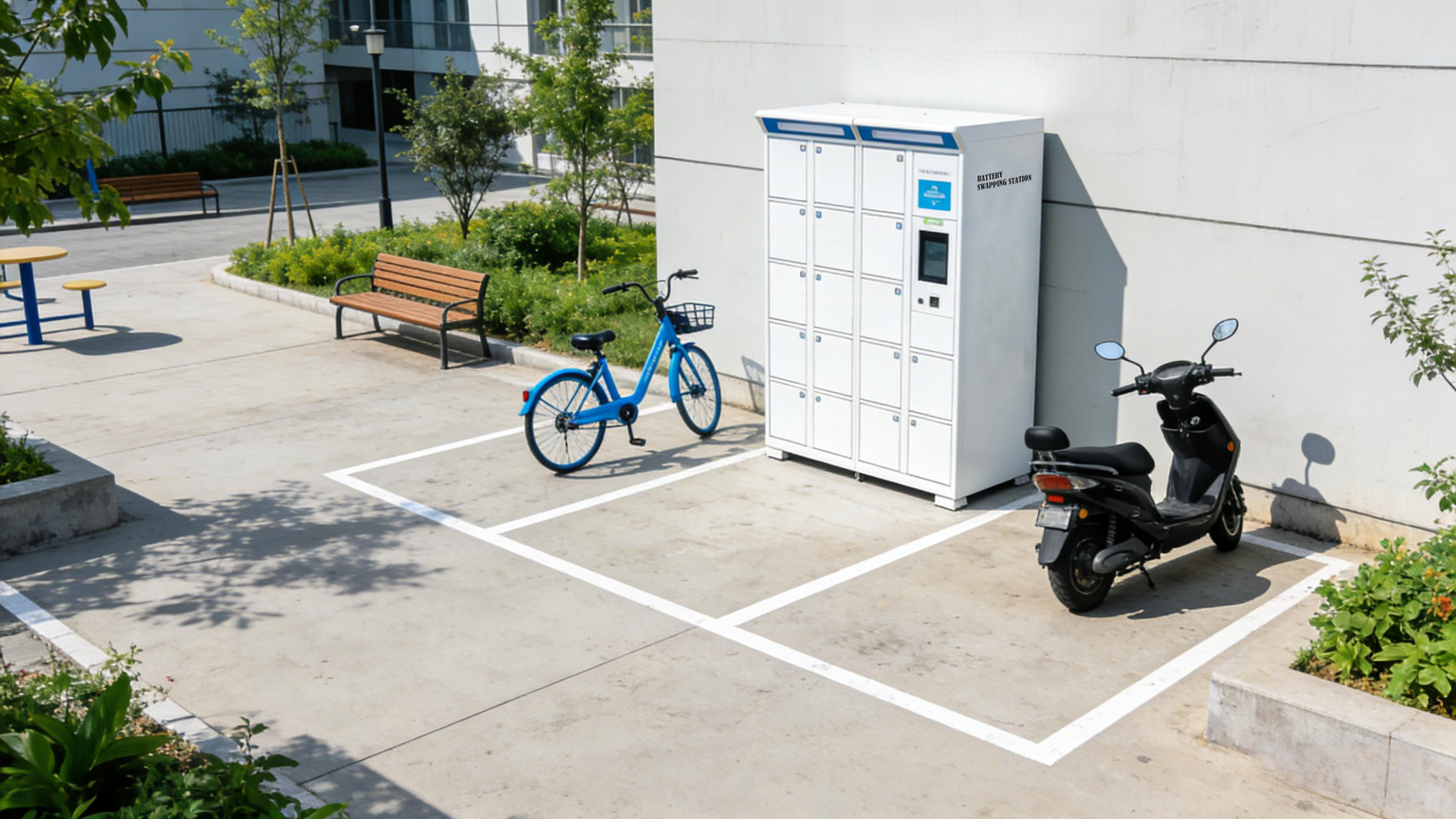
A battery swapping cabinet consists of two main parts: hardware equipment and software system. The hardware equipment mainly includes:
Cabinet structure: Made of cold-rolled steel plate, it must meet rust prevention, electrical strength, grounding and other protection requirements, with sufficient mechanical strength and weather resistance to adapt to the outdoor operating environment under Vietnam's tropical monsoon climate.
Battery compartment module: Each slot is equipped with a battery fixing device, swapping interface, door lock mechanism, etc. The typical single compartment size is about 260mm×400mm×220mm, which can accommodate standard electric motorcycle battery packs.
Charging module: Provides efficient charging function with a maximum output power of up to 4KW, supporting fast charging mode to shorten the battery turnover cycle.
Intelligent control unit: As the "brain" of the swapping cabinet, it is responsible for overall operation scheduling, status monitoring and remote communication.
Safety protection device: Including temperature control system, fire extinguishing device, explosion venting structure, video monitoring, etc., to ensure safe operation.
Taking a typical 12-slot intelligent swapping cabinet as an example, its overall dimension is about 483mm×553mm×1612mm, with a compact design suitable for deployment in limited spaces such as street corners and beside convenience stores.
3.3.2 Physical Standards for Battery Swapping Interfaces
The interface between the battery and the swapping cabinet is the key to realizing standardized battery swapping. The swapping interface is defined as a device for connecting and disconnecting the swapping battery with the vehicle, used to transmit electric energy, electrical signals and communication data. The interface design must meet the following requirements:
Physical performance: Good flame retardancy, voltage resistance, insulation resistance and temperature rise control to ensure safety and reliability under various working conditions.
Connection mode: Divided into soft connection interface and hard connection interface, which need to be selected according to specific application scenarios.
Standardized design: The implementation of the battery swapping mode requires unified standards, including battery interface, BMS communication protocol and battery size, which are crucial for building an open battery swapping ecosystem.
3.4 Intelligent Management System and Communication Protocols
3.4.1 Battery Management System (BMS)
The Battery Management System (BMS) is the technical core of the battery swapping solution, undertaking multiple functions such as battery status management, safety protection and information interaction. The BMS monitors key parameters of the battery in real time, including voltage, current, temperature, State of Charge (SOC) and State of Health (SOH), and conducts data analysis and fault early warning through intelligent algorithms.
In battery swapping scenarios, the BMS needs to solve the challenge of multi-battery collaborative management: how to accurately record the cycle count, historical trajectory and health status of each battery, and realize accurate binding and unbinding between user accounts and batteries during the swapping process. This requires the BMS to have highly reliable data storage and transmission capabilities.
3.4.2 Communication Protocol Architecture
The battery swapping cabinet system involves multi-level communication protocols, forming an interconnected neural network between devices:
Intra-cabinet communication: CAN bus communication is mainly adopted between the swapping cabinet and the BMS, following the CAN2.0B protocol and referring to international standards such as ISO11898-1 and SAE J1939-11. The communication content covers various message types such as handshake confirmation, parameter configuration, charging status and fault information, in compliance with industry specifications such as GB/T 42236.1.
Inter-cabinet communication: Data interaction between the swapping cabinet and the superior monitoring system is realized through network communication, supporting OTA remote upgrade to facilitate continuous iteration and optimization of system functions.
User interaction communication: Supports multiple methods such as NFC near-field communication and mobile APP remote control to provide a convenient user experience.
In addition, the system also supports multiple communication protocols such as RS485 serial port, MQTT protocol and TCP interface to meet data transmission needs in different scenarios.
3.5 Safety Protection System
Safety is the lifeline of the battery swapping cabinet solution. In view of Vietnam's tropical climate characteristics (high temperature, high humidity and heavy rain), the battery swapping cabinet needs to build a comprehensive safety protection system:
Electrical safety: Equipped with multiple mechanisms such as overcharge protection, over-discharge protection, short circuit protection and over-temperature protection, which automatically cut off the circuit when an abnormal state is detected.
Fire safety: Equipped with an automatic fire extinguishing device, which automatically starts the fire extinguishing program when thermal runaway risk is monitored; designed with an explosion venting structure to guide directional energy release in extreme cases and avoid catastrophic consequences.
Environmental protection: The cabinet reaches IP54 or higher protection level, effectively resisting rain and dust intrusion; equipped with an active heat dissipation system to ensure stable operation of equipment in high-temperature environments.
Data security: Adopts encrypted communication and identity authentication mechanisms to prevent account theft and transaction data leakage.
IV. Policy Support and Progress of Pilot Projects
4.1 National Strategic Planning
The Vietnamese government has taken electric transportation as an important part of the national energy transition. The approved green energy transition plan clearly promotes the production, assembly and use of electric vehicles, and actively promotes the construction of charging infrastructure. The Vietnamese government plans to restrict the use of fuel-powered motorcycles in city centers by 2030, and this policy expectation has created huge development space for the electric two-wheeler and battery swapping market.
In terms of regulations, Vietnam is improving the technical standard system in the electric motorcycle field, including battery standards (QCVN 91:2024/BGTVT) and motor standards (QCVN 90:2024/BGTVT), providing institutional guarantees for the healthy development of the industry. It should be noted that Vietnam has not yet issued national technical standards specifically for electric motorcycle battery swapping cabinets, and relevant specifications are under development.
4.2 Ho Chi Minh City Battery Swapping Cabinet Pilot Project
In January 2026, Ho Chi Minh City officially approved private enterprises to pilot the installation of 20,000 electric motorcycle battery swapping cabinets, which is the largest battery swapping infrastructure project in Vietnam to date. The project aims to solve the shortage of charging infrastructure and accelerate the green transportation transition, and is expected to complete full deployment in the first quarter of 2026.
Features of the pilot project:
Multi-stakeholder participation: Multiple enterprises (such as Great Wealth and V-Green) have proposed implementation plans, planning to install swapping cabinets on sidewalks or public light poles to make full use of urban space resources.
Open and compatible principle: Swapping cabinets must meet technical compatibility standards to ensure compatible use of multiple brands and models, avoiding closed barriers.
Transparent information disclosure: The location information of swapping cabinets must be publicly released for users to find and use easily.
Supporting policy connection: Starting from 2026, Ho Chi Minh City will officially implement an emission control plan, stipulating that only electric vehicles can be operated in the online car-hailing and express delivery industries, creating stable market demand for battery swapping services.
Ho Chi Minh City also plans to replace 400,000 fuel-powered motorcycles with electric ones by 2028, ban fuel-powered motorcycles for online car-hailing and food delivery in 2026, and implement a low-emission zone policy. These measures together form a policy mix for the promotion of electric motorcycles.
4.3 Local Policies and Incentive Measures
In addition to Ho Chi Minh City, other regions of Vietnam are also actively promoting the development of electric transportation. Hanoi has deployed 350 battery swapping cabinets through public-private partnerships, exploring the implementation of the "Battery as a Service" (BaaS) business model.
In terms of incentives, some regions have launched a "trade-in for battery swapping" program, providing purchase tax reductions and low-interest loans to lower the economic threshold for users to switch to electric motorcycles. Enterprises such as VinFast have also launched "oil-to-electric" activities to attract consumers through replacement discounts.
V. Major Participating Enterprises and Case Analysis
5.1 VinFast: Full Industry Chain Layout of a Local Leading Enterprise
As a leader of local electric vehicle manufacturers in Vietnam, VinFast has actively laid out in the field of electric motorcycle battery swapping. The company has launched a series of electric motorcycles supporting battery swapping (such as the Feliz S model) and has deployed electric motorcycle services (such as AhaFast freight service).
VinFast plans to accelerate the expansion of the electric motorcycle market and launch battery-swappable electric motorcycles to further enrich its product line. In terms of infrastructure construction, VinFast plans to promote the extensive deployment of charging and swapping stations through affiliated companies such as V-Green.
VinFast adopts a full industry chain layout strategy and has established partnerships with international enterprises such as LG Chem (battery supply), E.ON Drive (charging stations) and Bosch (charging points) to make up for shortcomings in the industry chain. This cooperation model has provided important support for the technological improvement of Vietnam's electric motorcycle industry.
5.2 Selex Motors: Explorer of Innovative Operation Models
Selex Motors is an innovative enterprise in the field of electric motorcycle battery swapping in Vietnam. Its electric vehicle battery swapping service launched in cooperation with Sơn Hà Energy Company allows users to complete battery replacement in just 2 minutes, and the swapping cost is 25%-35% lower than that of fuel. This case fully demonstrates the dual advantages of the battery swapping mode in economy and convenience.
The "Battery as a Service" (BaaS) model explored by Selex Motors separates batteries from vehicle sales: users do not need to pay for batteries when purchasing vehicles, but use battery services through subscription or pay-per-use, significantly reducing the initial vehicle purchase cost and accelerating the market penetration of electric motorcycles.
5.3 Honda Vietnam: Transformation Layout of a Traditional Giant
As a traditional leader in Vietnam's motorcycle market, Honda Vietnam is also actively laying out electric motorcycle battery swapping services. With its huge sales network and brand awareness, Honda has unique channel advantages in the electrification transition.
5.4 Overseas Opportunities for Chinese Enterprises
The development of Vietnam's electric motorcycle market has brought broad cooperation space for Chinese industrial chain enterprises. Panzhong Technology (Guangzhou) Co., Ltd., a professional manufacturer of new energy charging and swapping equipment, has set its sights on the Southeast Asian market. Its outdoor intelligent swapping cabinet products can adapt to mainstream brand models, providing a mature technical solution for the Vietnamese market.
In key components such as motors, batteries and electronic control systems, Chinese enterprises have extensive cooperation potential with the Vietnamese market. Through technology export, localized production or joint ventures, Chinese enterprises can deeply participate in the construction of Vietnam's electric motorcycle industry chain.
VI. Operation and Business Model Analysis
6.1 Business Model of Battery Swapping Services
A diversified business model is taking shape in Vietnam's electric motorcycle battery swapping cabinet market:
Pay-per-use mode: Users pay a fixed fee for each swap, suitable for low-frequency users. This method lowers the user's decision-making threshold, but requires operators to maintain competitiveness in pricing.
Monthly subscription mode: Users pay a monthly fee for unlimited swaps, suitable for high-frequency users (such as food delivery riders and online car-hailing drivers). This model helps form stable cash flow and user stickiness.
BaaS (Battery as a Service) mode: Battery assets are held by operators, and users do not need to purchase batteries when buying vehicles, but use battery services through subscription. This model separates battery costs from the vehicle purchase link, significantly reducing consumers' initial vehicle purchase costs, and entrusts the full life cycle management of batteries to professional operators, improving battery utilization efficiency and safety.
6.2 Cost-benefit Analysis
From the user's perspective, the battery swapping mode can reduce the usage cost by 25%-35% compared with fuel-powered motorcycles. Meanwhile, the swapping time is only about 2 minutes, greatly improving operation efficiency compared with the 4-6 hours waiting time of the traditional charging mode.
From the operator's perspective, the operating costs of battery swapping cabinets mainly include:
Equipment depreciation and maintenance costs
Electricity costs
Site rental costs
Battery asset management costs
Labor operation costs
Although the initial investment in battery swapping cabinets is high, the unit cost can be effectively diluted and profitability achieved through large-scale operation and intelligent management. Battery swapping cabinets support 24/7 unattended operation, greatly reducing labor costs.
6.3 Full-cycle Service System
A mature battery swapping solution needs to build a full-cycle and all-round service system. Taking Panzhong Technology as an example, it has built a complete service chain covering pre-sales, in-sales and after-sales, providing lifetime free software upgrade services to ensure continuous optimization of system functions and timely response to user needs. This service system is crucial for the long-term development of the Vietnamese market.
VII. Challenges and Solutions
7.1 Ununified Technical Standards
At present, there is no unified technical standard in the field of electric motorcycle battery swapping in Vietnam. Differences in battery specifications, interfaces and communication protocols among different brands and models restrict the interconnection of the swapping network.
Proposed solutions: Promote industry associations and government departments to take the lead in formulating unified technical standards covering core elements such as battery size, interface specifications and communication protocols, lower market entry barriers, and promote benign competition. We can learn from China's technical standards in the field of electric bicycle battery swapping cabinets and carry out localized adaptation according to the characteristics of the Vietnamese market.
7.2 Lack of Battery Recycling System
Vietnam currently lacks complete waste battery recycling regulations and treatment systems. With the expansion of the electric motorcycle scale, the environmental risk of retired batteries is becoming increasingly prominent.
Proposed solutions: Establish a full life cycle traceability system for batteries, clarify the extended producer responsibility system, encourage operators to build battery recycling and echelon utilization systems, and realize resource recycling.
7.3 Cultivation of Consumer Awareness and Trust
Some consumers have doubts about the performance and safety of electric motorcycles, and the acceptance of the battery swapping mode needs to be improved.
Proposed solutions: Strengthen public science education, enhance consumer confidence through the demonstration effect of pilot projects; improve the quality assurance and after-sales service system to eliminate users' worries.
7.4 High Initial Investment Cost
The construction of a battery swapping cabinet network requires a large amount of upfront capital investment, with a long investment recovery period, which puts high requirements on the financial strength of operators.
Proposed solutions: Explore diversified investment and financing models, introduce government guiding funds and social capital participation; reduce equipment costs through technological innovation; optimize site layout to improve single cabinet utilization.
VIII. Future Development Trend Outlook
8.1 Continuous Expansion of Market Scale
With the deepening of policy support and the improvement of consumer awareness, Vietnam's electric motorcycle battery swapping market will enter a period of rapid growth. It is expected that the construction of charging and swapping station infrastructure will become an important trend of industry development in the next five years. Ho Chi Minh City plans to complete the electrification transition of 400,000 fuel-powered motorcycles by 2028, which will release huge demand for battery swapping services.
8.2 Accelerated Technological Iteration
Intelligent upgrading: Technologies such as AI intelligent detection, big data analysis and intelligent scheduling algorithms will be deeply applied to the swapping cabinet system, realizing accurate prediction of battery health status, intelligent scheduling of swapping demand and continuous optimization of operation efficiency.
Modular design: Modular architecture will become the mainstream direction of swapping cabinet design, facilitating flexible expansion of the number of slots according to actual needs, lowering the initial investment threshold and improving deployment flexibility.
Multi-voltage compatibility: Support compatible swapping of multi-voltage level batteries to meet the diversified needs of different models and improve the universality of the network.
8.3 Business Model Innovation
Cross-border integration: Battery swapping cabinets will be deeply integrated with commercial facilities such as convenience stores, gas stations and restaurants, forming a "swapping + commerce" composite format to enhance the commercial value of sites.
Carbon trading mechanism: With the improvement of the carbon trading market, swapping operators can obtain additional income through carbon emission reduction transactions, improving project economy.
Data value-added services: User travel data, battery status data and other data accumulated by the swapping network can provide data support for urban planning, energy dispatch, insurance services, etc., opening up new value growth points.
8.4 Regional Market Linkage
The development of Vietnam's electric motorcycle battery swapping market will form a linkage effect with other Southeast Asian countries. Thailand, Indonesia, the Philippines and other countries also have huge motorcycle markets and face similar electrification transition pressures. Vietnam's successful experience can provide a reference for regional markets, and Chinese enterprises can also accumulate experience through the Vietnamese market to further expand the Southeast Asian regional market.
IX. Conclusion
The battery swapping cabinet solution for electric motorcycles in Vietnam is at a critical window period of development. Technically, mature battery management systems, intelligent swapping cabinet hardware and open communication protocol architecture provide a solid technical foundation for the solution; policy-wise, the government's strategic planning and pilot projects have created a favorable development environment; market-wise, the huge user base and rapidly growing electric motorcycle sales have laid a broad market space.
With its high efficiency, convenience, safety, reliability and affordability, the battery swapping mode is becoming the optimal solution to the charging problem of electric motorcycles in Vietnam. With the gradual unification of technical standards, continuous innovation of operation models and continuous improvement of the market ecosystem, Vietnam's electric motorcycle battery swapping market will usher in a golden period of development, providing a model for the green transportation transformation in Southeast Asia.
For Chinese industrial chain enterprises, the Vietnamese market contains huge opportunities. By exporting mature technical solutions, participating in localized operation cooperation and integrating into the regional industrial ecosystem, Chinese enterprises can play an important role in the construction of Vietnam's electric motorcycle battery swapping market and achieve a win-win development situation.
This report is compiled and analyzed based on public information. Technical parameters and market data are for reference only. The implementation of specific projects needs professional evaluation combined with actual situations.

表单2
邮件*
*