Comprehensive Overview of Malaysia's Electric Motorcycle Battery Swapping Solutions
This report is a comprehensive translation and adaptation of the original Chinese analysis, structured according to the style guidelines of Panzhong Technology's official documentation.
1. Technical Architecture: Building a Smart Swapping Ecosystem
1.1 Core Equipment and Hardware Systems
The battery swapping cabinet, as the physical carrier of the entire solution, features a multi-layered technical architecture encompassing several critical components and subsystems. The core devices include:Swapping Cabinet / Charge-Swap Cabinet This is the central physical facility providing both battery replacement and charging services. Its typical structure comprises a robust shell, multiple independent charging compartments, charging modules, a human-computer interaction interface, communication modules, and temperature control and safety protection systems.
Professional manufacturers, represented by Panzhong Technology, offer standard swapping cabinets ranging from 5 to 12 slots, allowing flexible configuration based on site conditions and user density.
Smart Battery Management System (BMS) The BMS serves as the "brain" of the swapping system, responsible for real-time monitoring of battery status, including temperature, voltage, current, and State of Charge (SOC), as well as providing communication interfaces and safety protection functions.
Advanced BMS systems enable full lifecycle data traceability for batteries, providing valuable data support for operational decision-making.
Standardized Swapping Interface
Mechanical + Wireless Communication
Compatibility
The swapping interface is crucial for achieving rapid connection/disconnection between the battery and the vehicle. It must support wired or wireless communication to ensure stability and security of data transmission. The industry is actively promoting interface standardization to resolve compatibility issues across different battery brands.
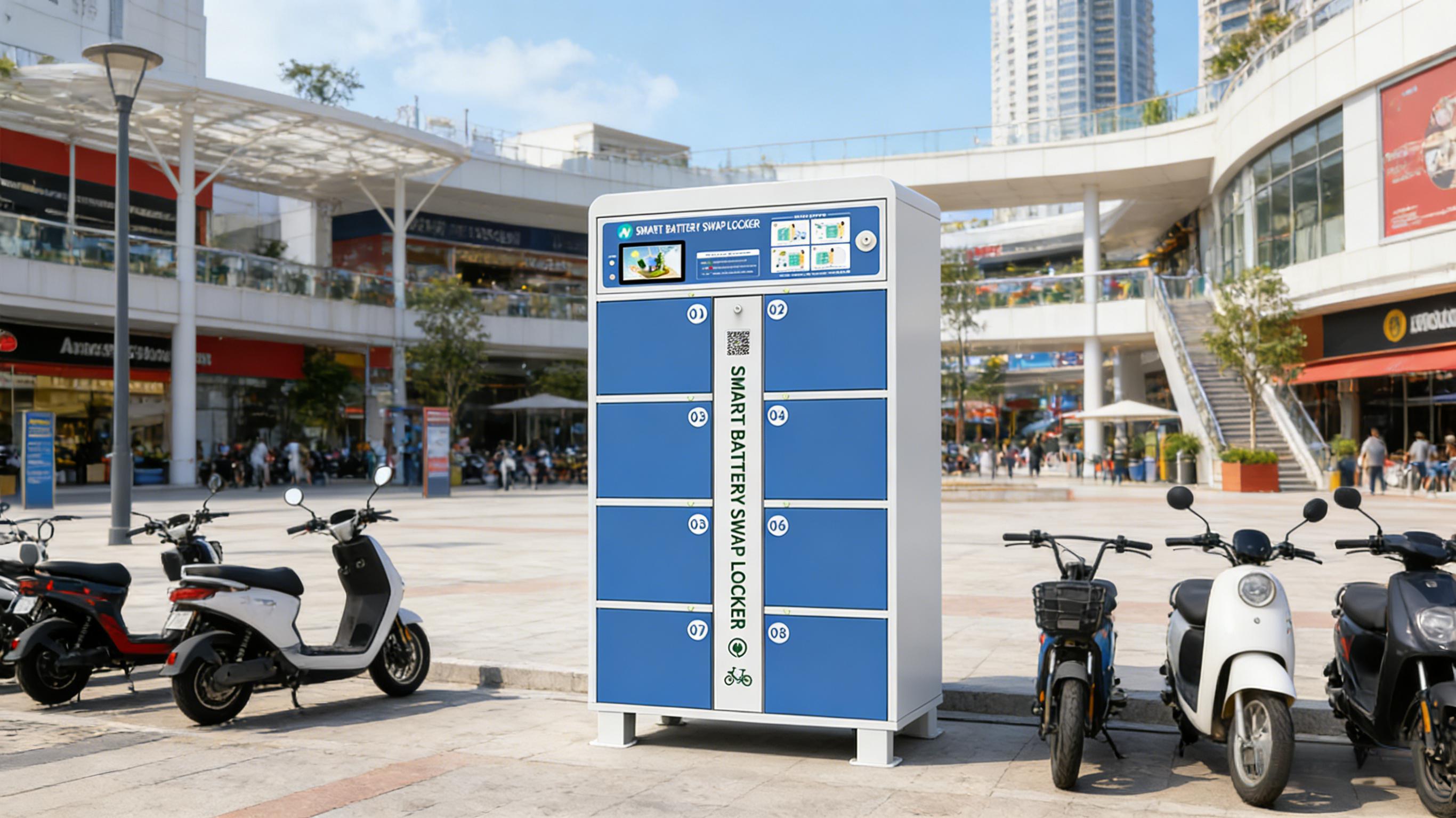
1.2 Software Platforms and Operational Systems
IoT Cloud Platform: Real-time device monitoring and management, enabling intelligent scheduling and anomaly alerts.
User Service Terminal: Mobile apps and mini-programs for station navigation, QR code swapping, balance inquiries, and subscription purchases.
Operational Management Backend: Comprehensive management for device, inventory, finance, user, and data analysis, supporting refined operational decisions.
1.3 Localization for Southeast Asia
Given Malaysia's tropical climate—characterized by year-round high temperatures, high humidity, and frequent thunderstorms—the equipment must meet specific reliability standards.Enhanced Protective Design Materials and processes such as 304 stainless steel frames, Dacromet coatings, and PTFE anti-corrosion layers are employed to withstand extreme conditions, achieving a salt spray resistance of ≥ 500 hours.
Wide Voltage Adaptation Accommodating regional power grid fluctuations, the cabinets support a wide input voltage range of 180-260V, equipped with voltage stabilization and surge protection devices, and also support offline swapping modes to ensure service continuity during grid instability.
1.4 Safety Assurance System
Safety is the lifeline of swapping services. A multi-tiered safety protection system includes:Electrical Safety
Equipped with leakage protection, power factor correction, and overcurrent/overvoltage protection functions.
Fire Safety
Features intelligent smoke detection, automatic fire suppression systems, and fire-resistant compartment designs to effectively prevent battery thermal runaway risks.
Battery Safety Monitoring
Real-time monitoring of battery temperature, voltage, and internal resistance, with immediate alerts and protective measures upon detecting anomalies.
2. Policy Environment: National Strategies Driving Industry Development
2.1 Government Incentive Policies
The Malaysian government places high importance on the development of the electric mobility industry, launching several robust incentive policies:Vehicle Purchase Subsidy Plan The "Electric Motorcycle Incentive Scheme" offers up to RM 2,400 (approximately CNY 3,600) for eligible purchases, targeting citizens with annual incomes not exceeding RM 120,000. This aims to lower entry barriers and promote the production of low-cost local models.
Tax Incentives Multiple tax incentive measures are implemented, including exemptions for electric vehicle import and consumption taxes, investment tax incentives for charging infrastructure construction, and personal income tax reductions.
Infrastructure Support The government actively promotes nationwide charging network construction, supporting charging station projects through special funds, and advocating for standardization of charging standards and interfaces.
2.2 National Strategic Planning
Low Carbon Mobility Blueprint (LCMB 2021-2030) A ten-year roadmap covering policy frameworks, infrastructure planning, and industry support.National Electric Mobility Blueprint A long-term strategic plan aimed at reducing greenhouse gas emissions and promoting energy transition.National Green Technology Policy An early policy framework supporting electric vehicle development, laying the foundational groundwork for industry growth.
3. Business Model: Building a Sustainable Profit Ecosystem
3.1 Main Business Model Types
The battery swapping service has formed mature business models in the Chinese market, offering valuable references for Malaysia:Basic
Charging Service Fee Model
Users pay per swap or per time unit.
Revenue covers equipment investment, electricity costs, site rent, and operational maintenance.
High Frequency
Battery Leasing Model
Strategic
OEM Collaboration Model
Operators collaborate with electric motorcycle manufacturers.
Shared construction and operation costs, joint promotion of products and services for mutual benefits.
Sustainable
Closed-Loop Ecosystem Model
Encompasses investors, manufacturers, battery suppliers, swapping station operators, mobility service providers, and users.
Forms a sustainable value chain ecosystem.
3.2 Revenue Sources Analysis
Primary revenue sources for swapping cabinet operators include:Swapping Service Fees Per-swap service fees, either based on electricity consumption or fixed pricing.
Membership Subscriptions Monthly, quarterly, or annual packages offering discounted or unlimited swapping privileges.
Battery Sales & Leasing Additional revenue from selling or leasing batteries stored in cabinets.
Advertising & Data Services Revenue from advertisements on HMI screens and value-added services based on operational data.
3.3 Malaysia Market Specific Considerations
The Malaysian market is in its early development stage, requiring tailored business models:
Target User Group: High-frequency users such as food delivery riders, logistics couriers, and express delivery personnel form the core user base.
Cost Management: High electricity connection costs in Southeast Asia necessitate strategies like reducing equipment power consumption and optimizing charging strategies.
Localization: Some Southeast Asian countries require local production for subsidies, necessitating local supply chain and manufacturing setups.
4. Market Landscape & Cooperation Modes
4.1 Major Market Participants
The Malaysian market is forming a diversified participant structure:Energy Companies e.g., Yinson Green Tech actively expands into the electric mobility sector, providing e-bike rentals and battery swapping solutions.
Petroleum Retail Companies e.g., PETRONAS Dagangan collaborates with Blueshark Ecosystem, leveraging existing fuel station networks to promote electric two-wheelers and energy solutions.
Power Companies e.g., Tenaga Nasional Bhd participates in charging infrastructure construction.
4.2 Cooperation Mode Exploration
5. Common Questions & Answers (Q&A)
Q1: What are the common problems during swapping, and how can they be resolved?
A1: Users may encounter the following issues and solutions:Battery Return Not Recognized: May be due to dust on the battery interface. Clean both the battery and cabinet interface with a dry cloth and retry.
No Available Batteries: Use the app to view nearby stations with available batteries.
Cabinet Offline or Faulty: If the equipment is offline, contact customer service or report through the app for timely maintenance.
Battery Quality Issues: If the retrieved battery shows abnormal power or cannot be used, promptly report through the app for replacement and inspection.
Q2: How does the swapping cabinet ensure battery safety?
A2: Professional swapping cabinets employ multi-layered safety measures:Smart Temperature Control Real-time monitoring of battery and cabinet temperature; automatic activation of cooling or alarms for abnormal temperatures.
Firefighting System Intelligent smoke detection and automatic fire suppression, capable of rapid response at the early stage of a fire.
BMS Monitoring 24/7 monitoring of battery status; immediate protection upon detecting overvoltage, high temperature, or other risks.
Q3: What scenarios are suitable for deploying swapping cabinets?
A3: The main suitable scenarios include:Food Delivery Stations Delivery riders are the core user group for swapping services; delivery stations are ideal deployment locations.
Residential Communities Addressing the challenges of unsafe or inconvenient charging for residents.
6. Development Trends & Outlook
6.1 Accelerated Standardization
Southeast Asian regions are actively promoting battery standardization and regional consensus to resolve compatibility issues. Malaysia is also expediting the formulation of electric motorcycle swapping standards, which will significantly reduce operator costs and enhance user experience.6.2 Huge Market Potential
Malaysia's large motorcycle ownership base is just beginning to electrify. Swapping models can effectively address range anxiety and uneven charging infrastructure distribution. Government subsidies will further stimulate market demand.6.3 Continuous Technological Innovation
Future swapping technology will evolve towards greater intelligence and convenience:Fully Automatic Swapping Implementation of robotic arms and other automation devices to achieve completely unmanned swapping services.
AI Intelligent Scheduling Utilizing big data and AI for smart battery scheduling and dynamic site optimization.